Nico Cappelluti
Associate Professor of Physics
University of Miami · Frost Institute for Data Science & Computing
I study how supermassive black holes formed and grew, where the cosmic X-ray background comes from, and whether some of the dark matter is made of black holes born in the first second after the Big Bang. My tools are deep, wide-field X-ray surveys, their multiwavelength counterparts, and gravitational waves.
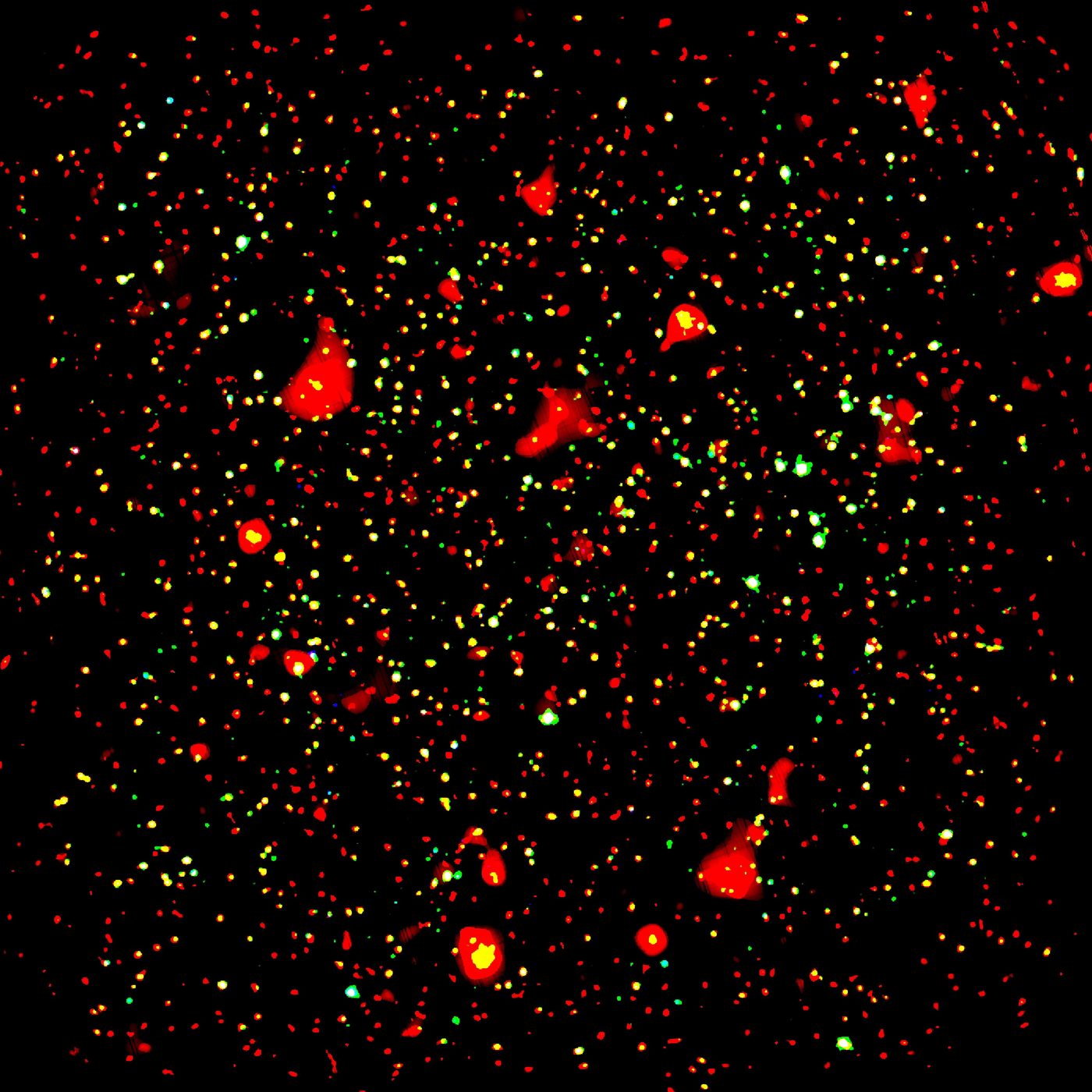
Black holes across cosmic time
Every galaxy with a bulge hosts a supermassive black hole of millions to billions of solar masses, and some were already in place when the Universe was less than a billion years old. My group uses surveys that cover large areas of sky to find the observational fingerprints of how those black holes were seeded and fed.
Growth of supermassive black holes
Active galactic nuclei in wide-field X-ray surveys from COSMOS onward, their clustering, their obscured populations, and stacking analyses with Chandra and JWST.
Origin of the cosmic backgrounds
What fraction of the X-ray and infrared backgrounds comes from resolved sources, and what the unresolved fluctuations say about the earliest black holes.
Primordial black holes and dark matter
Testing whether black holes formed in the early Universe make up part of the dark matter, using gravitational-wave events, including subsolar-mass candidates in LIGO–Virgo–KAGRA data.
X-ray searches for dark matter decay
Constraints on sterile-neutrino dark matter from the 3.5 keV line in deep X-ray data of the Milky Way halo and the cosmic background.
Dormant black holes nearby
A multiwavelength campaign on Gaia BH3, the 33 solar-mass dormant black hole in our Galaxy, building toward its periastron in late 2029.
The next X-ray observatories
- AXIS
- Chair, AGN Science Working Group for the Advanced X-ray Imaging Satellite, a NASA probe-class mission concept now in Phase A study. I developed the science case for supermassive black hole seed formation, which became the first pillar of the AXIS science case, and coordinate an international working group of more than 100 scientists.Advanced X-ray Imaging Satellite
- Lynx / AXIS
- Contributing to the science case for NASA's next strategic X-ray observatory under the ASTRA initiative.
- Collaborations
- Euclid-US; NASA–ESA Athena Working Groups on the missing baryons (1.4) and the earliest supermassive black holes (2.1); Steering Committee of the Stripe 82-AHA survey.
Current PhD students
- Joseph SterlingX-ray stacking of JWST-selected AGN · since 2022
- Umasree ThekkemadamMassive black holes in local dwarf galaxies · since 2022
- Aidan KaminskyX-ray studies of high-z JWST galaxies using the cosmic infrared background · since 2023 · NASA FINESST Future Investigator
- Alberto MagaraggiaCoherent CIB and CXB fluctuations with Euclid and eROSITA · since 2023
- Jack HuLarge language models for AGN cataloging · since 2023
- Rebeka Tamasi BöttgerAGN classification and population studies with AI · since 2023
Former PhD students
- Dominic SicilianPhD 2018–2022 · Sterile neutrino dark matter in the Milky Way halo · now Applied AI & ML, JPMorganChase
- Alessandro PecaPhD 2019–2024 · X-ray surveys, obscured AGN and AGN-DB · postdoc at Yale, now Pontificia Universidad Católica de Chile
- Giulia CeriniPhD 2019–2024 · Galaxy cluster dynamical state and scaling relations · now NASA Postdoctoral Program Fellow, JPL
Former postdoc
- Erwin T. LauPostdoc 2018–2022 · then Visiting Scientist, Smithsonian Astrophysical Observatory
Former undergraduate researchers
- Mert Okay2020–2022
- Justin Johnson2018–2020
Every student in the group writes and submits their own NASA proposals. Prospective students interested in X-ray astronomy, AGN or primordial black holes are welcome to get in touch before applying to the University of Miami physics PhD program.
Selected work
167 refereed papers and more than 15,000 citations; h-index 66 (NASA ADS, September 2026).
- 2026Magaraggia, A. & Cappelluti, N. Implications for primordial black hole dark matter from a single subsolar-mass gravitational-wave detection in LVK O1–O4. ApJ 1000, 262.
- 2025Kaminsky, A. J., Cappelluti, N., Hasinger, G., et al. Tracing high-z galaxies in X-rays with JWST and Chandra. ApJ 987, 40.
- 2024Cappelluti, N., Pacucci, F. & Hasinger, G. Constraining wind-driven accretion onto Gaia BH3 with Chandra. ApJ 973, 75.
- 2024Cappelluti, N., Foord, A., Marchesi, S., et al. Surveying the onset and evolution of supermassive black holes at high z with AXIS. Universe 10, 276.
- 2024Natarajan, P., Pacucci, F., Ricarte, A., Bogdán, Á., Goulding, A. D. & Cappelluti, N. First detection of an overmassive black hole galaxy UHZ1: evidence for heavy black hole seed formation from direct collapse. ApJL 960, L1.
- 2024Peca, A., Cappelluti, N., LaMassa, S., et al. Stripe 82-XL: the ~54.8 deg² and ~18.8 Ms Chandra and XMM-Newton point-source catalog and number counts. ApJ 974, 156.
- 2022Cappelluti, N., Hasinger, G. & Natarajan, P. Exploring the high-redshift PBH-ΛCDM Universe: early black hole seeding, the first stars and cosmic radiation backgrounds. ApJ 926, 205.
- 2020Sicilian, D., Cappelluti, N., Bulbul, E., et al. Probing the Milky Way's dark matter halo for the 3.5 keV line. ApJ 905, 146.
- 2018Kashlinsky, A., Arendt, R. G., Atrio-Barandela, F., Cappelluti, N., Ferrara, A. & Hasinger, G. Looking at cosmic near-infrared background radiation anisotropies. Reviews of Modern Physics 90, 025006.
- 2017Cappelluti, N., Li, Y., Ricarte, A., et al. The Chandra COSMOS Legacy Survey: energy spectrum of the cosmic X-ray background and constraints on undetected populations. ApJ 837, 19.
- 2013Cappelluti, N., Kashlinsky, A., Arendt, R. G., et al. Cross-correlating cosmic infrared and X-ray background fluctuations: evidence of significant black hole populations among the CIB sources. ApJ 769, 68.
- 2009Cappelluti, N., Brusa, M., Hasinger, G., et al. The XMM-Newton wide-field survey in the COSMOS field: the point-like X-ray source catalogue. A&A 497, 635.
Full list on NASA ADS and Google Scholar.
In the news: A potential discovery from the dawn of time, UM News, March 2026.
Background
- 2023–Associate Professor of Physics (tenured), University of Miami
- 2018–23Assistant Professor of Physics, University of Miami
- 2015–17YCAA Postdoctoral Prize Fellow, Yale Center for Astronomy and Astrophysics
- 2010–15INAF International Fellow, Istituto Nazionale di Astrofisica, Bologna
- 2008–15Visiting Research Scientist, University of Maryland Baltimore County
- 2007–10Staff Scientist, Max Planck Institute for Extraterrestrial Physics, Garching
- 2007PhD, Physics and Astronomy, TU München and IMPRS, with Günther Hasinger at MPE
- 2004MS, Astronomy, University of Bologna
Honors include the University of Miami Provost Research Award (2020, 2024), the YCAA Prize Fellowship (2015), and a Marie Curie Pre-Doctoral Fellowship (2004). Research supported by NSF, NASA ADAP, Chandra, JWST, NuSTAR and Swift.
Get in touch
ncappelluti [at] miami.edu
Office
Department of Physics
University of Miami
1320 Campo Sano Ave
Coral Gables, FL 33146